
In Conversation with Lindsay Stuart Hill
The poet on curating a debut collection and centering joy in revision in our first contributor interview


We’re so excited to publish our first of what we hope will be many Contributor Interviews today, featuring a conversation with poet, editor, and Issue One contributor Lindsay Stuart Hill. You can read it in full below.
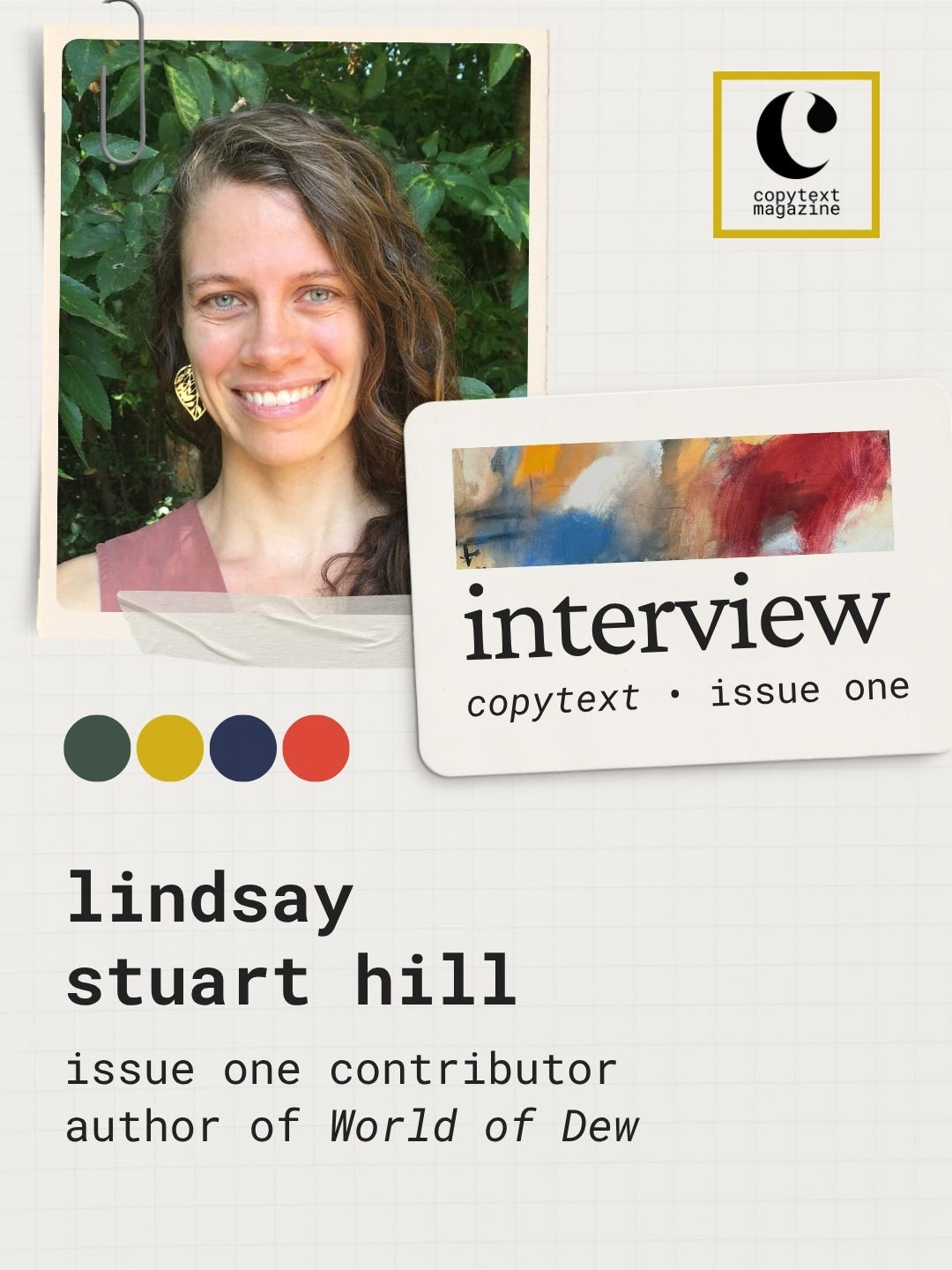
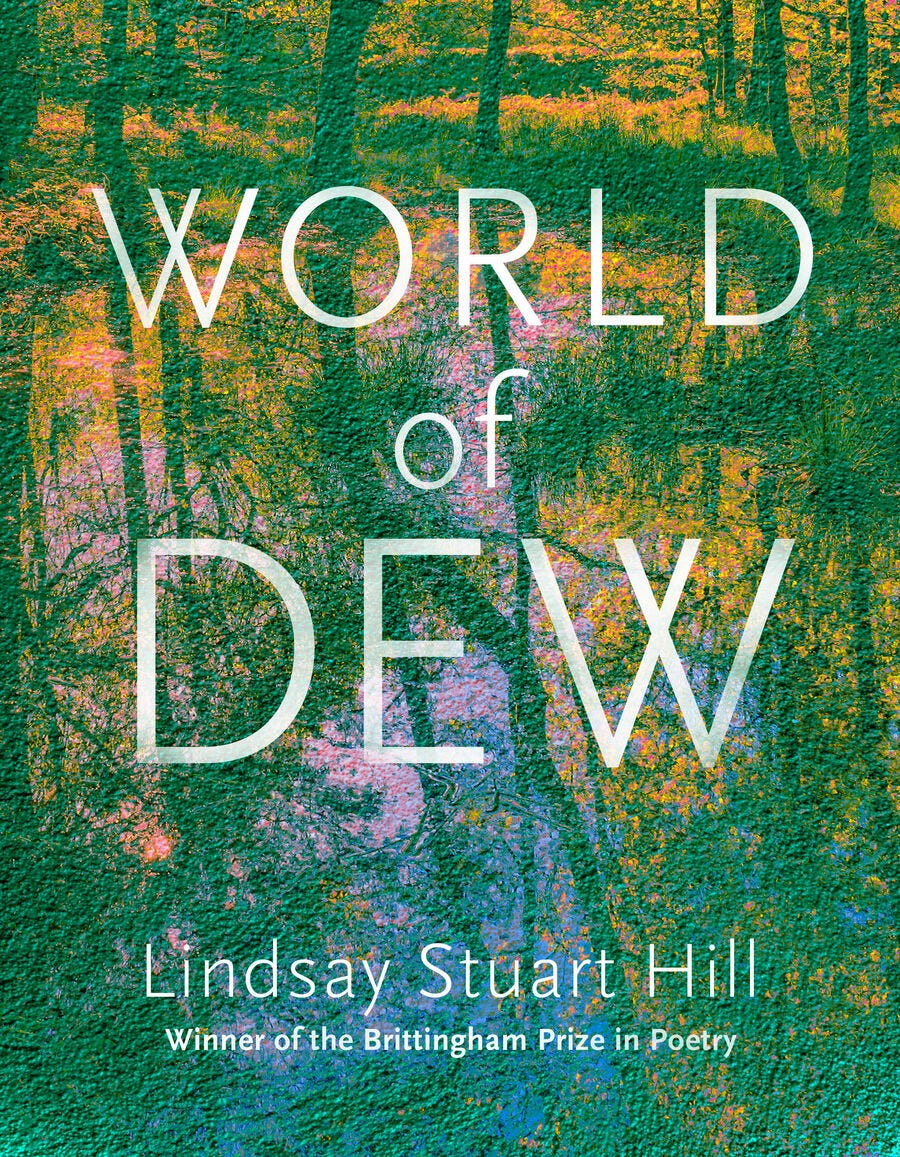
Interviewer Note: I had the immense joy of speaking with writer and editor Lindsay Stuart Hill, whose first full-length poetry collection, World of Dew (2025), won the Brittingham Prize in Poetry and was a finalist for the National Poetry Series. This collection is one I will be returning to again and again for its dynamic, clear lyricism, its compassionate witnessing of the world and of others, and its meditations on loss and impermanence. In our conversation, Hill generously spoke about her process, discussing specific revision choices, the curation of this debut collection, and what it means to have a life-long creative practice. Hill received her MFA from the University of Virginia, where she was the recipient of an Academy of American Poets Prize. Her poems have appeared in Poetry, Ploughshares, The Kenyon Review, and The Southern Review, among other publications. In Copytext, we were grateful to publish “When you get here, turn the light around to shine back.” and “Pine, n. and v.” and their earlier drafts in our inaugural issue. The following is an edited version of our conversation. — Lauren Frey, Co-Founding Editor-in-Chief

Lauren Frey
I’d love to start by delving into your poem, “When you get here, turn the light around to shine back,” which appears at the end of Part Two of your debut, World of Dew, and is featured alongside its earlier drafts in Issue One. I’ve been loving how the first draft contains so many images in the final version, like the room with no door, the hundred yellow boats, the line about barreling through the doorway of our mothers. Can you talk a bit about how this poem, over many years, found its form?
Lindsay Stuart Hill
I hadn’t thought about how those images were there from the beginning! Many of my poems start like this one, as free-writes without lineation—I try to give myself permission to let my mind wander. In this poem, I was responding to lines from an ancient Zen text called the Sandōkai, and I was seeing what images it sparked for me as I thought about a past relationship. That’s how you get constructions like “ten thousand cockroaches,” which doesn’t make it into the later drafts—“the world of ten thousand things” is a common epithet in Buddhism. Images like that were also dictated by the Sandōkai’s tone, which is capable of holding very big contradictions. It’s very authoritative and certain, yet it also points to great mystery and uncertainty.
LF
And with “the world of ten thousand things,” you were thinking of cockroaches!
LSH
Yes! I was recalling an apartment I lived in during my early twenties that may very well have had ten thousand of them.
LF
We see those lines in the Middle Draft, but ultimately, you decided to omit them. That’s one of the paradoxes of the writing process: sometimes the thing that we needed to start the piece can be taken away in the end.
LSH
That is such a common experience when you’re revising. Of course, you can get attached to those lines. I certainly do. There’s that famous writer’s maxim, “kill your darlings,” but when I’m working on a poem, I almost have to fall in love with it. Sometimes, I only realize I need to make cuts much later, and the parts that need to go can surprise me! With this poem, I was so intoxicated by my experience of writing the early drafts, which I did while lying on the floor, using colorful markers to help me feel freer and more adventurous. The Sandōkai was essential to that feeling—alternating the lines from it with my own stanzas gave the poem this exciting “call-and-response” effect. It was only after time had gone by and I received positive feedback on a version without those lines that I knew they were scaffolding.
LF
Going off this idea of letting your work surprise you, do you tend to let your work sit for a long time and then come back to it?
LSH
I definitely need to let my work sit. I’ve learned to do that, given how long it took me to publish World of Dew. A lot of time passed between the first and the final drafts of this poem. I try to pay attention to my innate sense of whether a poem is where I want it to be—or, if it feels finished, whether I feel ready to share it. With new work, there is always that infatuation stage for me. During my MFA, there were times when I had to turn in a poem for the week, but I hadn’t had enough time to let it really, truly sit. Those poems felt very fresh, not in the sense that they were rough or raw, but in that I was still infatuated with them. Then, when I received the workshop’s feedback, I’d realize that I wasn’t seeing the poem for what it actually was, and that could be painful! These days, I try to only share work with my writing group that has already sat for a while.
LF
I’d love to talk about World of Dew. Reading this collection gave me a feeling of expansiveness—of being able to take a wide embrace of the world through the lens of compassion, which I know is a core tenet in Buddhism. We’ve talked about that a bit before. How intentionally did that lens inform how you put this collection together?
LSH
My initial vision was for a collection more explicitly driven by Buddhist ideas, which have interested me for a while. I started meditating when I was fairly young; my mom got me Jon Kabat-Zinn’s Wherever You Go, There You Are when I was in high school. But it wasn’t until college that I started studying the texts, particularly the kōans. There’s a magical balance in kōans between the clarity of the language and the strangeness of what’s being said, and like the Sandōkai, they can contain these amazing contradictions. Early on, I envisioned this collection as one where every poem was inspired by a kōan, but at a certain point, that path stopped being generative for me. So I let the concept evolve, bringing in poems that spanned many different topics and approached Buddhist ideas in more implicit ways.
LF
I’ve been appreciating the journalistic quality of World of Dew, too. We meet so many people, go to so many places—from Hyderabad to your hometown. There is a kind of poetry of witness here—even how some poems explicitly insert the presence of the camera lens, which embeds and acknowledges that there is an act of witness and documentation at play.
LSH
I’m glad you brought that up! I write news stories for universities and nonprofits as part of my day job, so I think of myself as a pseudo-journalist. My mom was also a feature writer for an alumni magazine, so I think I inherited a journalist’s curiosity and drive to report things clearly and compellingly from her.
Part Two of the book is probably the most journalistic. It contains poems from my time living in India for about five months when I was studying abroad in college, and I wanted to capture what I witnessed there in a way that was both true to my own experience and respectful to the people I was writing about. I knew that to do that, I needed to stay aware of my own “lens,” which includes my limitations and blind spots. I revised the poems in that section so many times, trying to get it right, or as right as I could. Carolyn Forché’s book The Country Between Us was a big inspiration for me—she wrote about what she witnessed in El Salvador with such precision and compassion. I would also name Dien Cai Dau by Yusef Komunyakaa, who’s another sort of poet-journalist, as an influence.
LF
What was it like to compile all the poems in this book and order them into a complete body of work?
LSH
It was definitely a creative challenge to wrap my mind around how to structure and organize them. I remember one of my mentors, Elizabeth Spires, said to me, “This is your first collection. You’re introducing readers to your work. Make it really simple: You have childhood poems, you have India poems, you have Zen poems.” There was a simile she used: “Sometimes poetry is like plumbing.” I thought that was so funny!
LF
I love that she used that analogy.
LSH
That advice was huge for me—that I didn’t have to overcomplicate it.
As you said, there are so many places and people that this book includes. And then there are some poems I’ve written—like the other one that appears in Copytext, “Pine, n. and v.”—that didn’t make it into this collection at all, because I’m saving them for my next book! After I figured out the basic structure for this collection, a lot of it came down to trusting my own sense of which poems worked well together and remembering which poems had received the most positive responses from readers.
My mentors also taught me that readers will see connections in your work that you might not. The first poem in this book was written in 2008 or 2009, and the last poem was written in 2024. So I was trusting that readers would find ways to bring the poems together.
LF
That’s an incredible time range! I love that so much. It alleviates some pressure to know that a debut doesn’t have to include every strong poem you’ve ever written.
LSH
It’s good to have some generosity with yourself, your practice, and your writing, to trust that there will be places for poems even if they don’t make it into the first collection. Or even if they don’t make it into any collection.
LF
The idea that every poem you write helps you write the next one—even if it doesn’t get published.
LSH
Yes! That’s one of the difficult things for me. I have a real hunger to make poems and for the finished work to be out in the world, but it’s so important to prioritize the practice and the process. Having done this for as many years as I have, I know that’s what keeps me in it.
LF
What advice would you offer to writers who are building their first body of work?
LSH
Don’t forget to tap into the joy of writing and revising. There’s a certain satisfaction that comes with placing poems in journals and getting books published. But to have a writing practice in the long term, it’s important to make sure you don’t let publication get in the way of your personal relationship with writing. I’ve had to remind myself many times that poetry has value for me aside from whatever recognition I might get or not get, that I believe in this work and my relationship with it.
LF
I love what you’re saying—that, yes, publication scratches a certain itch, but what’s most important is your personal relationship to the work, which might mean setting aside, at least for a time, the idea of it being out in the world.
LSH
But I will also say, if you are sending poems out to journals and it’s not scratching some kind of itch, then try to find a way to make it do that! There was a poet in my MFA who used to reward himself with those Little Debbie Zebra Cakes every time he submitted to journals. There’s so much rejection, and you have to send out so much—I mean, the number of times I sent out the World of Dew manuscript in various forms—that you have to kind of gamify the process. So I’d advise finding something that helps you stay steady amid the sheer onslaught of rejection. Even if it’s just having a spreadsheet that automatically counts how many places you’ve sent a poem to, which is what I do. Then it starts to feel like collecting rejections, in a way that can be almost enjoyable.
LF
Any advice you would give about how to approach revision?
LSH
Give yourself permission to let go of your vision for what the poem “should” be, or even what you want it to be. This is advice I sometimes struggle to follow myself, but I think it helps to be flexible and try out different things. There’s a wonderful book by Kim Addonizio called Ordinary Genius with revision exercises to try with your poems. I used to have a revision day with my students where we would practice “cloning our darlings” (a phrase I stole from the author and educator Henry Hoke) rather than “killing” them. We’d make it fun and go, “Let’s make the poem a haiku, let’s make it three pages long, let’s write it from the perspective of someone else!” So I guess my revision advice would be to approach it with a sense of play.
LF
I love “clone your darlings”! Not to say that things shouldn’t end up on the cutting room floor, but to remember that a lot of what we write might have life to it if we return to it with curiosity.
LSH
Yes, you definitely need to let things go to the cutting room floor. But you never know when one of those scraps might resurface and how you might repurpose it. That’s part of the fun.